Slide
Slide 1 of 8
Tap outside image or press CLOSE to exit • Swipe or use arrows to navigate
ADULT RELATIONSHIPS TRACK

THE 4 LAWS

The Operating System for Human Relationships

THE NEEDTHE LAWENFORCEMENTOBEDIENCE
SAFETYLaw of LimitsForce - Stop violations immediatelyObey - Clarify and respect rights
POSSESSIONLaw of ResponsibilityCompensate - Make things rightEarn - Earn what you want
BELONGINGLaw of RespectExclude/Include - Filter toxic, fertilize goodGive Importance - Give due importance
CREATIONLaw of TalentEncourage - Fan the flameCreate - Turn consumption into creation

Session 1: The Sanctuary Journey

The Sanctuary Journey

⏱ 60-90 minutes

Begin Session 1 →

Session 2: Law of Talent

Starve the monster. Feed the Pearl.

Video 4: Culture of Trust Slide 1 of 8
Slide

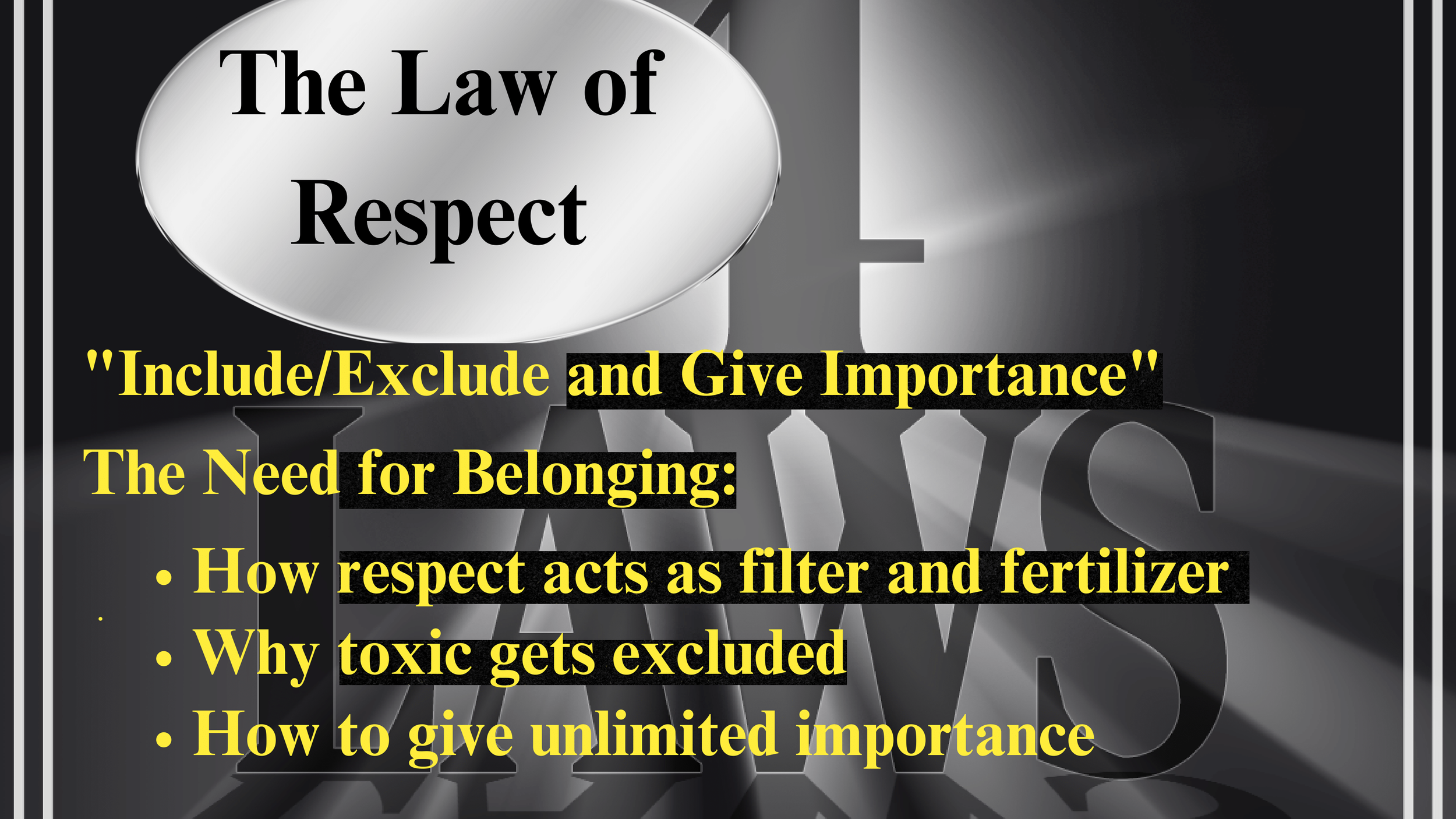
Session 3: Law of Respect

Filter toxins. Fertilize what grows.

Video 9: Law of Respect Slide 1 of 8
Slide

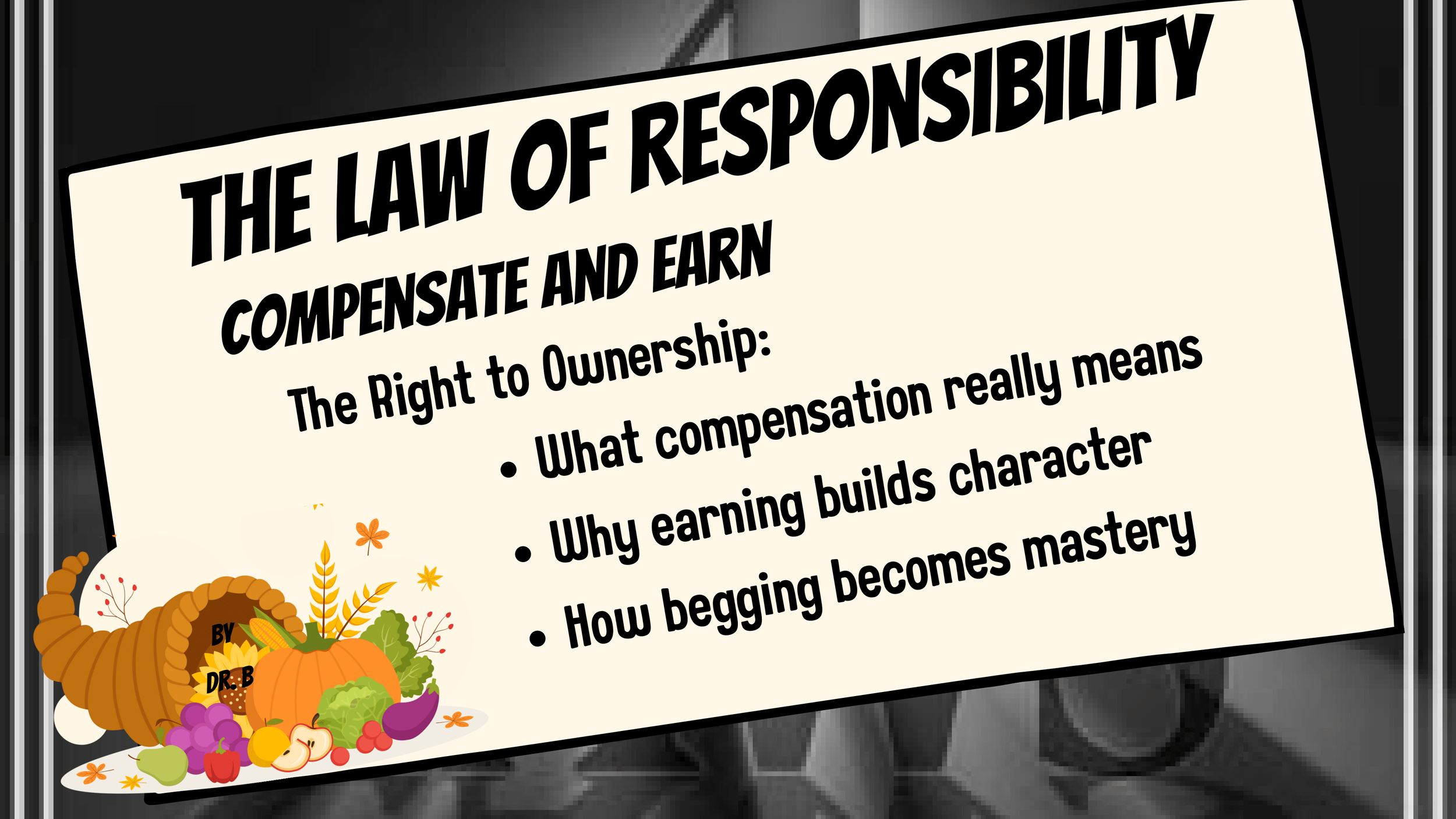
Session 4: Law of Responsibility

Begging becomes earning. Dependence becomes mastery.

Video 8: Law of Responsibility Slide 1 of 9
Slide

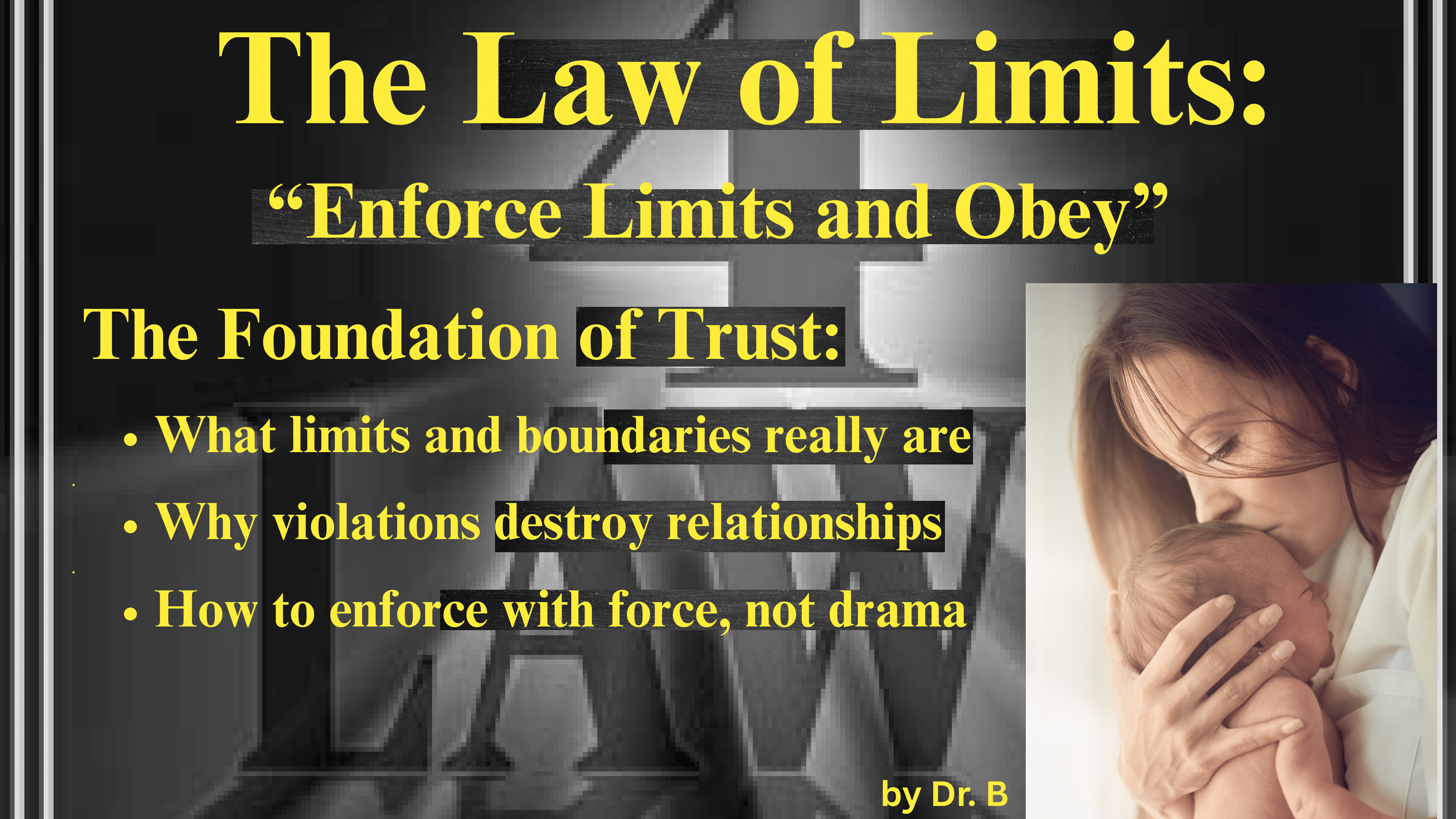
Session 5: Law of Limits

Safety foundation. Good fences make good relationships.

Video 7: Law of Limits Slide 1 of 7
Slide

Session 6: How to Know What to Do

The decision framework. Know which law to apply and when.

Every time someone acts out, they're telling you: "Some need I have got violated." Once you know WHICH need, you know EXACTLY what to do.

THE NEEDTHE LAWYOUR ACTION
SAFETYLaw of LimitsFORCE - Stop immediately
POSSESSIONLaw of ResponsibilityCOMPENSATE - Make it right
BELONGINGLaw of RespectEXCLUDE/INCLUDE - Filter toxic
CREATIONLaw of TalentENCOURAGE - Fan the flame

Every violation starts with Limits. Someone's rights got stepped on. Figure out WHICH right, then use THAT law's method.

TYPE 1: OPEN VIOLATIONS

Yelling • Stonewalling • Breaking agreements • Hostility

  • Name it calmly - "This is crossing a line"
  • No drama - Just STATE the boundary
  • Assess - Which need was violated?
  • Apply - Use that law's method

TYPE 2: SECRET VIOLATIONS

Lying • Financial deception • Emotional affairs • Hidden agendas

  • Act like you believe them - Document everything
  • Let them walk deeper - They'll show you more
  • Expose with calm - Show the evidence
  • Offer the choice - "Which relationship do you want?"

Practice Situation 1

Your partner dismisses something important to you mid-conversation: "That's not a big deal, you're overreacting." They turn back to their phone.
Apply the Framework: What need is threatened? Which law applies? What's your enforcement?
Need: Belonging | Law: Respect | Enforcement: Exclude/Include

Your need for belonging—to be heard, to matter—was violated. This is a respect issue.

Enforce the respect filter: Stop talking. Don't chase. Don't explain why you're hurt. Simply disengage. Turn your attention elsewhere.

When they approach you later with a respectful tone, you're available. Until then, disrespectful dismissal doesn't earn your engagement.

People get this wrong when they keep trying to explain, escalate emotionally, or demand attention. That's chasing respect—you can't force someone to give you importance.

Practice Situation 2

A colleague borrowed your notes for a presentation and presented your key ideas as their own in front of leadership, taking full credit.
Apply the Framework: What need is threatened? Which law applies? What's your enforcement?
Need: Safety AND Possession | Law: Limits FIRST, then Responsibility

Start with Limits: Your intellectual property was taken. A boundary was crossed. This needs to be named—not with anger, but with clarity.

Then Responsibility: They owe you compensation. Options: public acknowledgment of your contribution, a conversation with leadership to set the record straight, or a clear agreement about attribution going forward.

Approach the colleague directly: "Those ideas came from my notes. How do you want to make this right?" Give them choices.

People get this wrong when they either say nothing (enabling future violations) or explode publicly (making themselves look bad). Calm, direct, with choices.

Session 7: Role-Play Practice — Foundation

Knowledge lives in your head. Skill lives in your body. Role-play is the bridge.

THE ROLE-PLAY PROTOCOL

Step 1: Read the situation
Step 2: Role-play YOUR typical way
Step 3: Study the 4 LAWS response
Step 4: Role-play the 4 LAWS way
Step 5: Debrief - What shifted?
Step 6: Switch roles and repeat

Make it safe. Make it fun. Make mistakes.

Build confidence with self-focused scenarios, friendships, and workplace basics.

1. The Inner Critic

Respect + Limits
You have a voice in your head that constantly criticizes. Nothing you do is good enough. You anticipate failure. You rehearse embarrassments from years ago. The voice sounds like your own, but it's cruel in ways you'd never speak to anyone else.
The 4 LAWS Response:

This is a Respect violation—from YOU to YOU. The inner critic doesn't give you importance. It speaks to you with contempt.

Step 1: Recognize the critic as separate. That voice isn't YOU—it's a pattern downloaded from critical adults in childhood.

Step 2: Apply the Respect filter. Notice when the critic speaks. Label it: "That's the critic." Don't engage. Turn away.

Step 3: Practice selective inattention. The critic gets louder when you pay attention.

Step 4: Fertilize what deserves importance. What DID you do well today?

Step 5: Set limits with the critic:

"I'm not listening to this anymore. You don't speak for me."

Step 6: Protect your Talent fire. The critic attacks your creations. Your work deserves protection.

Why People Get This Wrong

They either identify completely with the critic (believing it IS them) OR they fight it head-on (which gives it energy). The 4 LAWS approach: recognize it as separate, apply the respect filter, practice selective inattention, set internal limits.

2. Procrastination and Self-Sabotage

Responsibility + Talent
You have important goals—a project, a health change, a creative dream. You know what to do. But day after day, you don't do it. You scroll instead of working. Then you feel guilty, which makes you procrastinate more.
The 4 LAWS Response:

This is a Responsibility violation against yourself—you're not earning the life you want.

The Other Side: Too Much Fire. There's another variant: being so consumed by your talent that you put off other responsibilities. You have so much fire that you leave everything else for later. Solution: Finish an important segment, then compensate by getting caught up on your Smart Day routines.

The Smart Day Principle: Whatever you do today, you will likely do tomorrow.

Step 1: Design one "Smart Hour" first. Morning is best.

Step 2: Make the good choice easier than the bad choice. Phone in another room.

Step 3: Connect to your WHY. If you can't find it—maybe it's not your work to do.

Step 4: Apply Responsibility to yourself. You must earn what you want.

Step 5: Exclude the guilt. Fertilize the wins. "I showed up today."

Why People Get This Wrong

They either beat themselves up (feeding shame) OR make elaborate plans that last three days. The 4 LAWS approach: design one Smart Hour, make good choices easier, connect to your WHY, exclude guilt, fertilize every small win.

3. The One-Sided Friendship

Respect + Responsibility
You have a friend who only calls when they need something. You listen to their problems for hours, but when you share yours, they change the subject. You initiate every hangout. You feel drained after every interaction.
The 4 LAWS Response:

This is a Respect violation—you're not receiving the importance you're giving.

→ See the Order of Importance in the Law of Respect chapter

Step 1: Stop over-functioning. Stop initiating. This is data collection.

Step 2: Observe what happens. Some friendships balance. Others fade.

Step 3: Set gentle limits on emotional labor:

"I can talk for about 15 minutes—then I have to go."

Step 4: Ask for what you need:

"I've been going through something. Can we get coffee this week?"

Step 5: Reduce investment to match theirs.

Step 6: Grieve if needed. Redirect your energy to relationships that reciprocate.

Why People Get This Wrong

They either keep giving until depleted OR confront dramatically. The 4 LAWS approach: stop over-functioning, observe, filter your giving, ask directly, match investment level.

4. Friend Violating Boundaries

Limits + Respect
A close friend shares your private information with others. They make jokes at your expense in group settings. When you mention it, they say "You're too sensitive." The friendship has history, but you're tired of feeling disrespected.
The 4 LAWS Response:

This is a Limits violation—your right to privacy and dignity is being crossed.

Step 1: Name the specific behavior:

"When you shared what I told you about my marriage with the group, that wasn't okay."

Step 2: State your need:

"I need to be able to trust that what I share stays between us."

Step 3: Name the consequence:

"If it happens again, I'm going to step back from the friendship."

Step 4: For "too sensitive"—filter it:

"I'm not asking you to agree. I'm telling you it matters to me."

Step 5: Follow through if behavior continues.

Step 6: Recognize when history isn't enough.

Why People Get This Wrong

They either tolerate it indefinitely OR end abruptly without giving it a chance. The 4 LAWS approach: name specific behavior, state need, be clear about consequences, filter dismissive responses, follow through.

5. Boss Crossing Boundaries

Limits + Respect
Your boss emails you at 10 PM expecting immediate responses. They schedule meetings during your lunch break. They've asked you to work weekends "just this once" three months in a row. When you hint at boundaries, they say "That's just the culture here."
The 4 LAWS Response:

This is a Limits violation—your fundamental right to rest and sustainable work is being crossed.

Step 1: Clarify your own limits internally first.

Step 2: Enforce through action, not confrontation. Just stop responding at 10 PM.

Step 3: Offer alternatives:

"I have a commitment during lunch. Can we do 2 PM instead?"

Step 4: If pushed, name your need calmly:

"To do my best work, I need to protect some personal time."

Step 5: The Respect filter: Don't absorb their urgency as your emergency.

Step 6: For extreme cases—document everything. Know your employee rights.

→ See Session 6: Sanctuary Protocol for covert violations

Why People Get This Wrong

They either silently comply until burnout OR explode in dramatic confrontation. The 4 LAWS approach: enforce through quiet action, offer alternatives, name needs calmly, document violations in extreme cases.

6. Colleague Taking Credit

Limits + Responsibility + Respect
A colleague presents your ideas as their own in meetings. When you mention it privately, they say "We're a team." Your boss doesn't seem to notice who originated what.
The 4 LAWS Response:

This is THEFT—a covert violation of your intellectual property. Three laws: Limits (rights violated), Responsibility (they're taking without earning), Respect (you're not receiving due importance).

Step 1: Document everything. Email summaries: "Following up on my idea to [X]..."

Step 2: Make contributions visible:

"Building on the approach I developed last month…"

Step 3: Address directly (private, calm):

"Ideas I originated have been presented without attribution. I need that to change."

Step 4: The Respect filter: "We're a team" isn't teamwork—that's theft.

Step 5: If needed, escalate appropriately (in writing to boss).

The Talent connection: Protecting your creative output is honoring your talent.

Why People Get This Wrong

They either stay silent (enabling theft) OR confront aggressively (looking like the problem). The 4 LAWS approach: document, make contributions visible, address calmly, escalate in writing if needed.


Session 8: Role-Play Practice — Advanced

Multi-law situations. Higher stakes. Integration mastery.

Navigate complex dynamics in couples, family of origin, and existential challenges.

7. The Silent Treatment Standoff

Respect + Limits
Your spouse is upset about something you said three days ago. Instead of discussing it, they've gone cold—one-word answers, sleeping on the edge of the bed. You've apologized twice but got "It's fine" both times. The tension is suffocating.
The 4 LAWS Response:

The silent treatment is a Respect violation—they're excluding you from importance. But chasing them is ALSO a respect violation.

Critical Principle: Don't announce—just DO. When you enforce one of the 4 LAWS, you don't need to talk about it. You do it. Saying "I notice you're still upset..." is like asking permission. You're feeding the Monster.

You don't explain to a person being filtered out. You talk AFTER they return.

→ See the Order of Importance on the Couples page

The shift: Lower them in the Order of Importance immediately. Make something else most important. Don't announce it. Just do it.

Apply the Respect filter to yourself: Exclude their coldness from affecting your day. Maintain your warmth and routine.

The Natural Law of Balance: Give the importance they give you. When they approach with importance, reciprocate.

If it continues for weeks—watch for covert violations: When negativity lasts more than a day or two, something deeper may be wrong. Act oblivious. See where the importance goes. Document. Gather evidence.

→ See Session 6: Sanctuary Protocol for covert violations

Why People Get This Wrong

They either chase endlessly (rewarding silent treatment) OR escalate to anger (matching disrespect). The 4 LAWS approach: don't announce—adjust Order of Importance silently, protect yourself with the respect filter, give importance when they return, watch for covert violations if chronic.

8. Unequal Division of Labor

Responsibility + Respect
You work full-time and handle 80% of household tasks. Your partner works similar hours but comes home and relaxes. When you bring it up, they say "Just tell me what to do." Nothing changes.
The 4 LAWS Response:

This is a Responsibility violation—they're not earning their share of family possession.

Critical Shift: Do less. Allow discomfort. The answer is NOT a "reset conversation." Compensate according to what they earn. Do less—minimal responsibilities, safe but uncomfortable.

Give less. Allow things to go undone, enough for them to protest. Mirror a bit of their attitude. "I'm tired." Give what they earn.

This is a gradual process: You contribute less. But check you don't expect more than their capacity. You are stronger. Give more—but enough for them to feel the gap and grow.

Wait for the earnest approach: When they come with genuine willingness—THEN let them design their contribution. Not before.

Let THEM design it: "What parts of running this household are you willing to OWN completely?"

Let natural consequences teach: If they own dinner and don't do it? The family doesn't eat. You don't rescue.

Fertilize genuine effort:

"Thank you for handling dinner. That made my evening so much better."
Why People Get This Wrong

They either become the martyr (resentment until explosion) OR nag constantly OR call a "reset conversation" that changes nothing. The 4 LAWS approach: do less, allow discomfort, wait for earnest approach, let them own tasks, allow natural consequences.

9. The Disconnection Spiral

Talent + Respect
You and your partner live in the same house but feel like roommates. No intimacy—physical or emotional. Conversations are logistics only. You can't remember the last time you laughed together. "Date nights" feel forced and awkward.
The 4 LAWS Response:

This is a Talent violation—you've stopped creating together. Connection isn't something you have—it's something you CREATE.

Small creations restart the fire: Cook a meal TOGETHER. Take a walk with no agenda. Create a future together: "What do we want our life to look like?"

Key Insight: It doesn't have to be "create together."

Encourage your partner to create. Be on fire yourself. When you're lit up with your own passion—they will miss you. They will thank you. They will miss you soon enough.

Your fire is attractive. Your passion draws them. Don't wait. Create, and let your fire pull them in.

The Respect component: Filter out past disappointments. Don't approach with "We never connect anymore." Fertilize any spark when it appears.

Watch for the monster: Criticism, contempt, coldness. The "pearl" is whatever drew you together originally.

If they don't respond: That's data. After consistent effort: "I'm putting energy into connecting with you, and I'm not feeling it returned. What's happening?"

Why People Get This Wrong

They either blame their partner OR accept roommate status. The 4 LAWS approach: recognize connection as creation, be on fire yourself, volunteer creation without waiting, filter past disappointments, fertilize any spark.

10. The Controlling Parent

Limits + Respect
You're an adult with your own family, but your parent still tries to control your decisions. They criticize your parenting, your spouse, your career. They use guilt: "After everything I've done for you." When you set boundaries, they escalate—crying, silent treatment, or calling other family members.
The 4 LAWS Response:

This is a Limits violation—they're crossing into territory that belongs to you as an adult.

Step 1: Clarify limits internally. What decisions are YOURS? All of them.

Step 2: Set limits without explaining:

"Mom, I've decided how we're handling this. I'm not open to input on this one."

Not: "Well, experts say…" Just: "This is decided. Let's talk about something else."

Step 3: Respect filter when they escalate:

"I can see you're upset. I love you, and my decision stands."

Step 4: For "flying monkeys" (family pressure):

"This is between me and Mom. I'm not discussing it with you."

Step 5: Gift of distance when needed. This isn't punishment—it's protection.

Step 6: Fertilize any respect they show:

"Thanks for understanding, Mom. Now, tell me about your trip."

You're training them: respect gets connection. Disrespect gets distance.

Why People Get This Wrong

They either submit to maintain peace (losing themselves) OR cut off completely in anger (losing connection). The 4 LAWS approach: set limits without justification, filter emotional reactions, maintain boundaries consistently, take distance when needed, fertilize any respect.

11. The Sibling Who Takes

Responsibility + Limits + Respect
Your sibling always needs something—money, a place to stay, help with their crisis of the week. They never reciprocate or even acknowledge the sacrifice. Now they're asking again, and family pressures you: "That's what family does."
The 4 LAWS Response:

This is a Responsibility violation—they're taking without earning or compensating.

Step 1: Recognize the pattern. Helping doesn't help. It enables.

Step 2: Stop rescuing. Rescuing prevents natural consequences.

"I'm not in a position to help with money right now."

You don't need to explain. "I'm not in a position" is complete.

Step 3: For family pressure:

"I've helped [sibling] many times. I'm not the right person this time."

Step 4: If you choose to help—make it Responsibility-based:

"I'll help with rent this month. Here's what I need in return: [specific action]. This isn't a gift—it's an agreement."

Step 5: Separate love from rescue:

"I love you, and I'm not able to help with this."

Step 6: If they escalate with screaming—Limits AND Respect filter (exclude the tone):

"I won't continue this conversation while you're speaking to me this way."
Why People Get This Wrong

They either give until resentment explodes OR cut off with guilt. The 4 LAWS approach: recognize the pattern, stop rescuing, make help conditional, separate love from rescue, set limits on how you're treated, exclude disrespectful tones.

12. Trapped in the Wrong Job

Talent + Responsibility
You dread Monday mornings. Your work feels meaningless. You're good at your job, but it doesn't connect to anything you care about. Every day feels like trading life hours for a paycheck. But the pay is stable, you have responsibilities, and you don't know what else you'd do.
The 4 LAWS Response:

This is a Talent violation against yourself—your work isn't lighting your fire.

The Law of Talent says: Your vocation should be tied to your dreams, to your unique gifts. When work is pure consumption, your soul starves.

Step 1: Don't quit—excavate first. What DID light your fire? What would you create if money weren't an issue? Write these down. This is your talent map.

Step 2: Find the spark within your current role. What tasks make time disappear?

Step 3: Start creating on the side. A side project. Learning skills. Connecting with people in fields that energize you.

Step 4: Law of Responsibility—earn the transition: Save money. Build skills. Create a portfolio.

Step 5: Design your Smart Day even within the trap. Whatever you do today, you'll likely do tomorrow. Practice excellent form—habits of excellence transfer.

The timeline: This isn't fixed overnight. 6 months, a year, two years. But movement toward your vocation is better than resignation to a life of consumption.

Why People Get This Wrong

They either stay forever (soul death by inches) OR quit dramatically without a plan (responsibility violation). The 4 LAWS approach: excavate what lights your fire, find sparks within current work, create on the side, earn the transition, practice excellence even while trapped.

COURSE RESOURCES

📚 Situation Room

Browse all 12 scenarios anytime. Your reference library.

Enter Situation Room →

📝 Worksheets Hub

All 10 interactive exercises in one place.

Open Worksheets →

🎯 Find the Need

Interactive tool to identify which need is threatened.

Find the Need →

🏠 Sanctuary Protocol

Work through situations with the 4 LAWS mindset.

Sanctuary →